%20(7).avif)
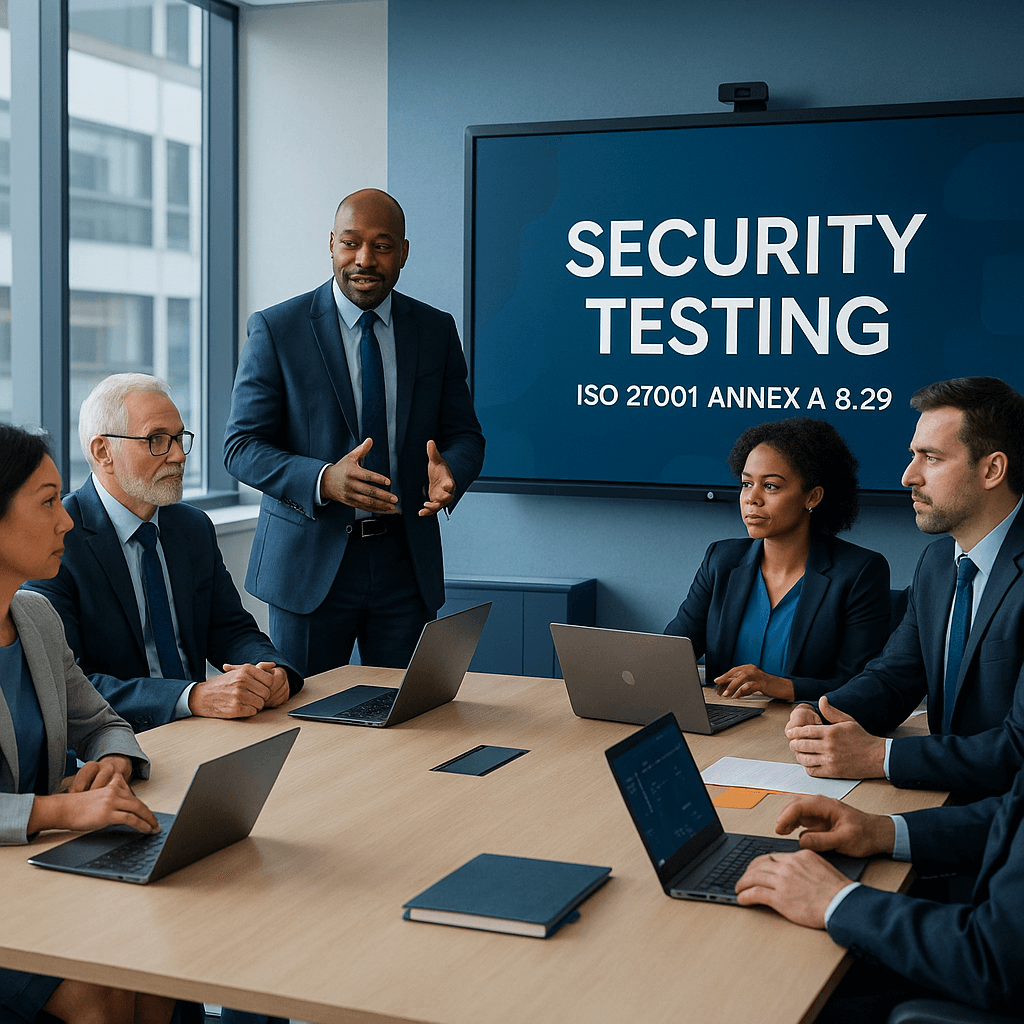
Skipping proper security testing is like launching a ship without checking for leaks—you might stay afloat for a while, but the risks are enormous.
That’s exactly what ISO 27001 Annex A 8.29 is designed to prevent.
It ensures that security testing is built into every stage of development and acceptance, so vulnerabilities are caught before deployment, not after.
The result? Stronger applications, smoother audits, and greater trust from clients.
In this guide, we’ll break down what Annex A 8.29 requires, how to implement it step by step, and the best practices to keep your testing sharp and effective.
Let’s dive in.
ISO 27001 Annex A 8.29 Explained
What is ISO 27001 Annex A 8.29 Security Testing in Development and Acceptance?
ISO 27001 Annex A 8.29 is all about making sure your software development and acceptance processes are secure. It’s a set of guidelines that ensures every stage of your secure development lifecycle is tested for vulnerabilities before your product is released. Think of it as a security checkpoint for your software. You don’t want any threats slipping through the cracks, right? To implement this, you need to:
- Incorporate security testing at every stage of development.
- Test both new features and updates.
- Ensure that acceptance criteria include security validation.
By doing this, you’re locking down your application’s defences before it ever faces the real world.
What is The Purpose of ISO 27001 Annex A 8.29?
So, why does ISO 27001 Annex A 8.29 exist? According to ISO 27001, the purpose of Annex A 8.29 is:
To validate if information security requirements are met when applications or code are deployed to the production environment.
Source: ISO/IEC 27001:2022
This guideline pushes you to test rigorously, ensuring that your application is robust and secure before it goes live. It’s about proactive protection. Here’s what to focus on:
- Identify Weaknesses Early: Catching issues in development saves headaches (and money) later.
- Build Confidence: Knowing your software has been tested thoroughly gives you peace of mind.
- Compliance and Trust: Meeting these requirements shows your commitment to security, building trust with clients and partners. This isn’t just a box to tick - it’s a crucial step in protecting your business.
ISO 27001 Annex A 8.29: What Is The Requirement
ISO 27001 Annex A 8.29 requires you to ensure:
Security testing processes shall be defined and implemented in the development life cycle.
Source: ISO 27001
This security testing should be performed against new systems, upgrades and new versions; and cover both functional and non-functional requirements. Here’s what you need to do:
- Embed Testing in Development: Ensure security tests are part of your regular development process, not an afterthought.
- Define Clear Criteria: Know what needs to be tested, when, and how.
- Document Everything: Keep records of tests performed, results, and any actions taken.
By understanding this requirement, you’re ensuring that security is baked into your software from the start - not bolted on at the end.
Why is ISO 27001 Annex A 8.29 Important?
ISO 27001 Annex A 8.29 is crucial because it helps you stay ahead of potential threats. Imagine launching your software only to discover a critical vulnerability that could have been caught with proper testing. In fact, according to a study done by Veracode, over 75% of applications have at least one flaw. By embedding security testing into your development and acceptance processes, you can reduce the likelihood of vulnerabilities existing in your code. That’s a nightmare scenario! Here’s why it matters:
- Prevents Security Breaches: Early detection of vulnerabilities can prevent costly breaches.
- Ensures Compliance: Following this guideline is essential for ISO 27001 certification.
- Protects Reputation: Secure software builds trust with users and clients. By prioritising this, you’re not just avoiding risks—you’re actively protecting your business’s future.
What are the Benefits of ISO 27001 Annex A 8.29?
Following ISO 27001 Annex A 8.29 offers a range of benefits that go beyond just compliance. It’s about creating a more secure, resilient product. Here’s what you gain:
- Reduced Risk: Proactively identifying vulnerabilities means fewer chances of exploitation.
- Cost Savings: Fixing issues early in development is far cheaper than patching them post-release.
- Increased Trust: Clients and partners feel confident knowing your software is secure and meets international standards.
- Streamlined Processes: With clear testing procedures in place, your development process becomes more efficient. The real benefit? Peace of mind knowing your software is strong, secure, and ready for anything.
Key Considerations When Implementing ISO 27001 Annex A 8.29
Best Practices for Implementing ISO 27001 Annex A 8.29 Security Testing in Development and Acceptance
Implementing ISO 27001 Annex A 8.29 effectively means embedding security testing right into your development process. Here’s how to do it:
- Integrate Early: Begin security testing during the initial stages of development, not after the code is complete.
- Automate Testing: Use automated tools to continuously scan for vulnerabilities throughout the development cycle.
- Use Multiple Testing Methods: Combine static code analysis, dynamic testing, and penetration testing to cover all bases.
- Collaborate Cross-Functionally: Ensure developers, testers, and security teams work together to identify and fix issues early.
Remember, the goal is to catch vulnerabilities before they become problems. By integrating security testing into your process from the start, you build a stronger, more secure product.
Integrate with Related ISO 27001 Annex A Controls
When it comes to application security, ISO 27001 Annex A 8.29 Security Testing in Development and Acceptance works hand in hand with other ISO 27001 Annex A Controls. These include:
- ISO 27001:2022 Annex A 8.25 Secure Development Lifecycle
- ISO 27001:2022 Annex A 8.26 Application Security Requirements
- ISO 27001:2022 Annex A 8.27 Secure Systems Architecture and Engineering Principles
- ISO 27001:2022 Annex A 8.28 Secure Coding
- ISO 27001:2022 Annex A 8.30 Outsourced development
- ISO 27001:2022 Annex A 8.31 Separation of development, test and production environments
- ISO 27001:2022 Annex A 8.33 Test information
By being aware of these relationships, you can adopt a more integrated approach to application security.
Identifying Potential Weakness in ISO 27001 Annex A 8.29 Security Testing
Identifying weaknesses in your security testing process is crucial. Here’s how you can spot the gaps:
- Review Past Incidents: Analyse previous security breaches or issues to understand where testing failed.
- Conduct Regular Audits: Conduct regular internal audits to evaluate your security testing process.
- Involve External Experts: Bring in third-party security experts to perform independent security reviews.
- Gather Feedback: Collect feedback from developers and testers on where they feel vulnerabilities might exist.
Spotting these weaknesses early allows you to patch the holes before they’re exploited. The sooner you identify potential weaknesses, the more secure your development process will be.
Strategies for Maintaining ISO 27001 Annex A 8.29 Security Testing
Maintaining the effectiveness of security testing under ISO 27001 Annex A 8.29 requires ongoing effort. Here’s how to keep your testing sharp:
- Regularly Update Tools: Ensure your testing tools are always updated to detect the latest threats.
- Continuous Training: Provide ongoing training for your team to keep them aware of new vulnerabilities and testing techniques.
- Reassess Testing Methods: Periodically review and refine your testing methodologies to adapt to new challenges.
- Document and Analyse Results: Keep thorough records of testing outcomes and use them to improve future testing efforts.
By maintaining a proactive approach, you ensure that your security testing remains effective and aligned with the latest threats and technologies.
Guidance for Documenting ISO 27001 Annex A 8.29 Security Testing
Proper documentation is essential for ISO 27001 Annex A 8.29 compliance. Here’s how to ensure your documentation is complete:
- Record Testing Procedures: Document the exact steps taken during security testing, including tools used and methods applied.
- Log Test Results: Keep detailed records of what each test revealed, including any vulnerabilities found and their severity.
- Track Remediation Actions: Clearly document what actions were taken to mitigate risk.
- Maintain Version Control: Ensure that all documents are kept up-to-date with the latest information and changes.
Good documentation not only supports compliance but also provides a valuable resource for improving future testing processes.
Guidance for Evaluating ISO 27001 Annex A 8.29 Security Testing
Evaluating the effectiveness of your security testing is key to continuous improvement. Here’s how to assess it:
- Analyse Testing Coverage: Ensure all critical areas of your application have been thoroughly tested.
- Review Incident Response: Evaluate how well your team handles security issues discovered during testing.
- Measure Against KPIs: Use key performance indicators like the number of vulnerabilities found and the time taken to resolve them.
- Solicit Feedback: Get input from your team on what worked well and where improvements are needed.
Regular evaluation helps you identify gaps, refine processes, and strengthen your overall security posture.
8 Steps To Implementing Security Testing in Development and Acceptance
Implementing security testing in development and acceptance needs some careful planning and execution. To help you achieve success, here's my 8 step guide to implementing ISO 27001 Annex A 8.29. TL:DR
- Step #1 - Understand your business needs
- Step #2 - Identify your assets
- Step #3 - Perform a risk assessment
- Step #4 - Develop policies and procedures
- Step #5 - Implement controls
- Step #6 - Training and awareness
- Step #7 - Evaluate effectiveness
- Step #8 - Continual improvement
Let's explore each of these steps in more depth.
Step #1 - Understanding the Requirement
Before diving into security testing for ISO 27001 Annex A 8.29, you must understand what’s expected. This requirement isn’t just about running tests; it’s about ensuring your software development and acceptance processes are bulletproof. You need to integrate security testing at every stage - design, development, and deployment. Ask yourself: What are the specific security threats your organisation faces? How can testing mitigate these risks? Understanding the requirement means knowing that security testing isn’t just a task - it’s a commitment to protecting your business. When you grasp this, you’ll be ready to build a solid security foundation.
Step #2 - Identify Your Assets
Identifying your assets is like taking inventory before setting out on a journey. You need to know exactly what you’re protecting. Start by listing all your critical data, applications, and systems involved in the development process. Which assets are most valuable? Which would cause the most damage if compromised? Categorise your assets by sensitivity and impact. This will help you prioritise your security testing efforts. Knowing your assets means you can focus your testing where it matters most, ensuring nothing vital slips through the cracks.
Step #3 - Perform a Risk Assessment
Performing a risk assessment is like scoping out the battlefield before launching an attack. You need to know where the threats are coming from. Start by identifying potential vulnerabilities in your development and acceptance processes. What are the worst-case scenarios if these vulnerabilities are exploited? Rank these risks by likelihood and potential impact. This helps you understand where to focus your testing efforts. A solid risk assessment will give you a clear picture of where your defences need to be strongest, setting the stage for effective security testing.
Step #4 - Develop Policies and Procedures
Now that you know your risks, it’s time to set the rules. Developing policies and procedures ensures everyone in your organisation is on the same page. Start by defining what needs to be tested, how often, and by whom. What are the exact steps for conducting each type of test? Who is responsible for what? Document everything - this becomes your playbook for security testing. Clear policies and procedures eliminate guesswork and ensure consistency, so you can move forward with confidence knowing your team knows exactly what to do and when to do it.
Step #5 - Implement Controls
Implementing controls is where the rubber meets the road. It’s time to put your plans into action. Start by setting up technical controls, like automated security scans and penetration testing tools. Which controls will be most effective for the risks you’ve identified? Don’t forget administrative controls - establishing review processes and ensuring that your team follows procedures. Implementing controls isn’t a one-time task; it’s an ongoing effort. Keep fine-tuning to make sure your security measures are as strong as possible.
Step #6 - Training and Awareness
Even the best controls can fail if your team isn’t on board. Training and awareness are crucial. Regularly educate your staff on the importance of security testing and how they can play a part. How can you make security practices a habit rather than a chore? Use interactive sessions, real-life examples, and hands-on training to make the information stick. The goal is to create a culture where security is everyone’s responsibility. When your team understands the why and how of security testing, they’re more likely to catch potential issues before they become big problems.
Step #7 - Evaluate Effectiveness
Once your controls are in place and your team is trained, it’s time to evaluate how well everything is working. Use metrics and KPIs to measure the effectiveness of your security testing processes. Are the tests identifying vulnerabilities? Are remediation steps being implemented effectively? Regular audits and reviews help you stay on track. Gather feedback from your team to identify areas for improvement. Evaluating effectiveness isn’t just about finding flaws - it’s about continuously refining your approach to ensure your security measures are as robust as possible.
Step #8 - Continual Improvement
Security is never a set-it-and-forget-it process. Continual improvement ensures that your security testing stays effective as new threats emerge. Regularly update your policies, procedures, and controls based on the latest security trends and lessons learned from past incidents. What worked well? What didn’t? Incorporate new tools, techniques, and best practices into your security testing. Encourage a mindset of constant learning and adaptation within your team. By committing to continual improvement, you’re not just reacting to threats - you’re staying ahead of them.
ISO 27001 Annex A 8.29 - What An Auditor Looks For
You Have Documented Information About ISO 27001 Annex A 8.29 Security Testing in Development and Acceptance
Documenting your security testing processes is crucial. It’s not just about having paperwork—it’s about creating a solid foundation for your security strategy. You need to clearly record every step of your security testing, from initial planning to final results. This documentation should include:
- Test plans and objectives: What are you testing, and why?
- Test methodologies: How are you conducting these tests?
- Test results: Document what you find, good or bad.
- Remediation actions: What steps will you take to fix any issues?
Keep these records up-to-date and easily accessible. They’re not just for audits—they’re your roadmap for continuous security improvement.
You Are Managing ISO 27001 Annex A 8.29 Security Testing Risks
Managing risks in security testing is all about being proactive, not reactive. You need to anticipate potential issues before they become real problems. Here’s how:
- Identify vulnerabilities early: Regularly scan and test your systems during development.
- Prioritise risks: Focus on high-impact vulnerabilities that could seriously harm your business.
- Mitigate identified risks: Implement fixes or controls to reduce the impact of these vulnerabilities.
- Monitor continuously: Keep an eye on your systems even after testing, as new risks can emerge.
By staying ahead of potential threats, you ensure that your security testing is more than just a formality - it’s a powerful defence mechanism.
You Have Policies and Procedures for ISO 27001 Annex A 8.29 Security Testing in Development and Acceptance
Policies and procedures aren’t just bureaucratic red tape - they’re the backbone of your security testing strategy. To be effective, these documents should:
- Define clear roles and responsibilities: Who is doing what in the testing process?
- Standardise testing methodologies: Ensure that all tests are performed consistently and effectively.
- Outline incident response protocols: What happens when a vulnerability is found?
- Specify documentation requirements: What needs to be recorded and reported?
Make sure your team is familiar with these policies and knows exactly how to follow them. Consistency is key, and well-crafted policies ensure that your security testing process runs smoothly every time.
You Are Promoting ISO 27001 Annex A 8.29 Security Testing in Development and Acceptance
Promoting security testing within your organisation is all about building a culture of security. It’s not enough to just have policies in place - everyone needs to understand and embrace them. Here’s how to foster that culture:
- Conduct regular training: Keep your team updated on the latest security testing practices.
- Communicate the importance: Ensure everyone understands why security testing is critical to your business’s success.
- Encourage collaboration: Foster open communication between development, security, and operations teams.
- Celebrate successes: Acknowledge when security testing catches potential issues - it reinforces its value.
By making security testing a priority for everyone, you create an environment where security is second nature.
You Are Driving Continuous Improvement in ISO 27001 Annex A 8.29 Security Testing in Development and Acceptance
Continuous improvement is the name of the game in security testing. Cyber threats evolve, and so should your security practices. To drive continuous improvement:
- Regularly review and update your testing procedures to reflect new threats and technologies.
- Solicit feedback from your team on what’s working and what’s not.
- Implement lessons learned from past tests and incidents to enhance future testing.
- Stay informed about industry trends and incorporate new best practices.
Continuous improvement keeps your security testing sharp, effective, and ahead of the curve. It’s not just about staying safe today - it’s about being prepared for tomorrow.
Conclusion
Security testing isn’t just a compliance checkbox—it’s the shield that keeps vulnerabilities from slipping into production and threatening your business. ISO 27001 Annex A 8.29 makes it clear: testing must be embedded into your development and acceptance processes if you want to build secure, resilient software.
We’ve walked through the essentials:
- Integrate security testing from the start of development
- Use multiple testing methods like SAST, DAST, and penetration testing
- Define clear policies, procedures, and acceptance criteria
- Document every step and result for accountability
- Continuously evaluate and improve to stay ahead of new threats
By following these practices, you’re not just meeting ISO 27001 requirements—you’re building trust, avoiding costly breaches, and giving your business the confidence to innovate securely.
If you found this guide helpful and want more practical, step-by-step advice on ISO 27001 and cybersecurity, subscribe to the GRCMana Newsletter today. Stay informed, stay compliant, and stay secure.
Frequently Asked Questions
What is ISO 27001 Annex A 8.29 and why is it important for security testing in development and acceptance?
How does ISO 27001 Annex A 8.29 integrate with other ISMS controls for secure software development?
What are best practices for protecting test environment data in compliance with ISO 27001 Annex A 8.29?
What tools and methods are effective for evaluating compliance with ISO 27001 Annex A 8.29 in security testing?
How can organizations maintain and improve the effectiveness of security testing under ISO 27001 Annex A 8.29?

Harry West
Harry is a Global CISO and ex-Senior Leader at Microsoft and Rackspace with over 20 years leading security and compliance programs for financial services and critical infrastructure. He holds CCSP and ISO 27001 Lead Implementer certifications and specializes in building scalable GRC programs. Harry has designed ICT risk management programs, third-party risk frameworks, and resilience testing capabilities aligned with regulatory expectations.


